
Generating search engine traffic is becoming increasingly challenging in the AI era. Users are clicking through to websites less frequently, opting instead to read AI-generated summaries directly on the search results page.
To succeed in this landscape and secure sustainable organic traffic, you need a highly effective SEO content strategy that aligns your business goals with evolving search algorithms. This guide provides a step-by-step framework to build a resilient strategy that drives consistent results. You will learn how to convert readers into customers.
What is an SEO Content Strategy?
An SEO content strategy is a comprehensive plan to research, create, organize, and optimize content to rank well in traditional search results and get cited in AI-powered search experiences. A good content strategy fills the gap between pure writing and the technical requirements of search engines. Instead of writing random topics, it ensures every piece of content serves a clear purpose for both users and search algorithms.
Why Having a Content Strategy is Important for SEO
Search engines like Google prioritize websites that demonstrate deep topical authority. A well-mapped content roadmap allows you to signal your expertise to search crawlers and provides a seamless experience for your audience. Here are the main benefits of a well-planned SEO content strategy:
- Topical authority: Writing in depth on specific subjects signals to search engines that your site is a trusted resource, which is especially important for AI search optimization.
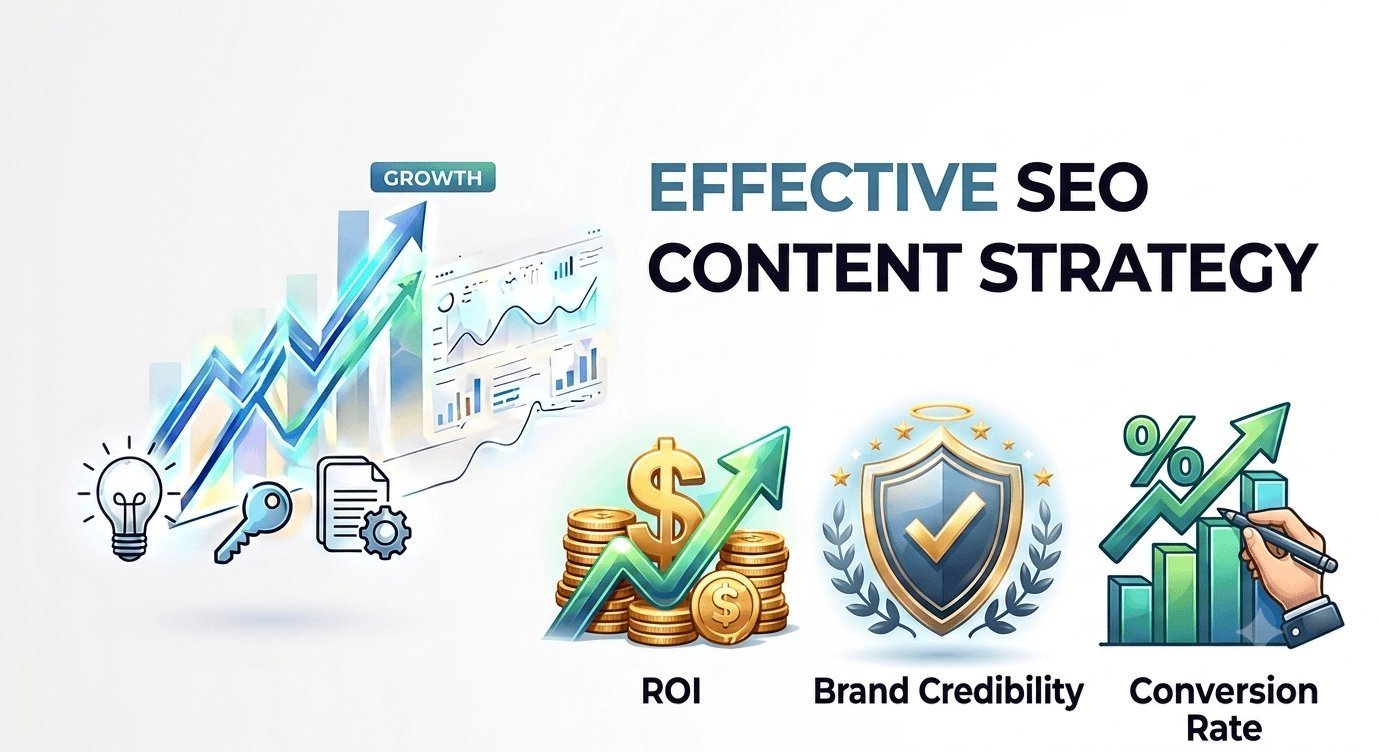
- Compounding ROI: Unlike ads that stop working when you stop paying, optimized blog posts can drive consistent traffic for years.
- Higher conversion rates: When you target searchers who are actively seeking answers, you can capture users with high purchasing intent.
- Crawler efficiency: An integral part of any solid SEO content strategy is interlinking related articles, which helps search bots discover and index your pages faster.
- User experience (UX): Interlinked content leads readers naturally from one related topic to the next, increasing time spent on your site.
- Brand credibility: A good content strategy allows your website to appear consistently in search results across a buyer’s entire search journey. This builds trust in your brand as one of the industry leaders.
Ultimately, a properly implemented content strategy transforms your website from a simple collection of pages and articles into a highly efficient customer-acquisition machine.
Key Components of an Effective Content Strategy
Set Clear Goals and Categorize Your Content Actions
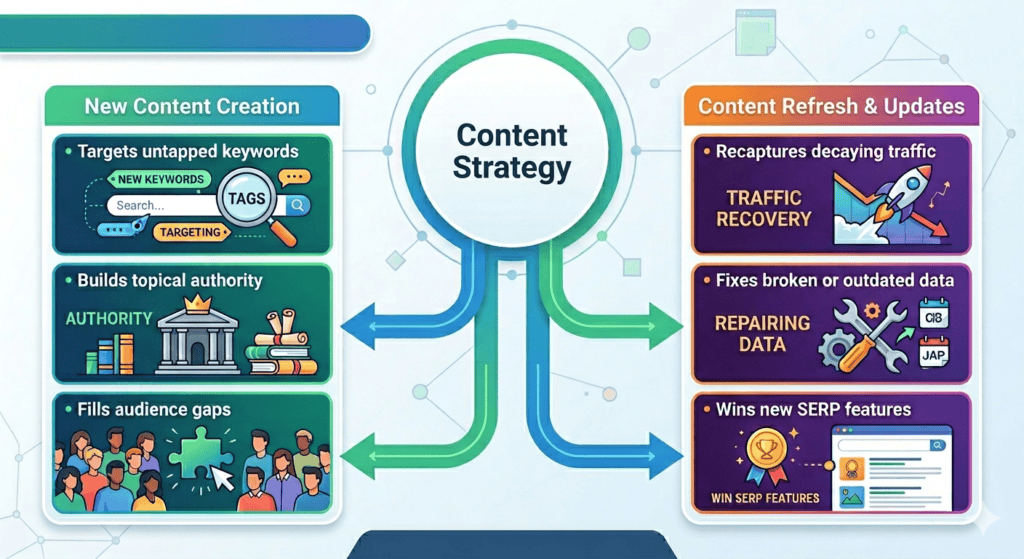
Before researching keywords, you need to identify exactly what you want your SEO content strategy to accomplish. Are you trying to build brand awareness, or are you looking to generate immediate product sign-ups? Once your goals are set, you can categorize your content efforts into two primary categories: new content creation and existing content optimization.
Creating new content helps you:
- Target untapped keywords: Capture new search queries that your website does not currently rank for.
- Fill content gaps: Answer specific questions your competitors might be missing.
- Build topical authority: Establish deep expertise by expanding your site’s coverage of a subject.
Refreshing and updating existing content helps you:
- Recapture declining search traffic: Boost rankings for older pages that have lost visibility over time.
- Fix broken or outdated data: Ensure your information remains accurate, reliable, and trustworthy for users.
- Win new SERP features: Target modern search results elements, like citations in AI Overviews.
To align your strategy with actual business goals, you should decide whether to create new content or update existing assets based on your objectives:
- For quick sign-ups or sales: Focus on creating new, high-intent pages like product reviews, comparison guides, and pricing landing pages.
- For initial brand awareness: Prioritize writing new educational articles and broad industry overviews to introduce your brand to new audiences.
- For traffic retention: Audit your existing content to identify top-performing pieces that simply need fresh data, new examples, or updated links to maintain their current rankings.
When you directly align content actions with your business goals, you ensure that each piece of content serves a clear and measurable purpose.
Conduct Keyword Research
Detailed keyword research is the heart of your SEO content strategy. Without it, you are essentially guessing what your audience cares about. Good keyword research should take into account the following aspects:
- Search intent: Determine if a user wants to learn something (informational), find a specific brand (navigational), or buy a product (commercial and transactional).
- Search volume and keyword difficulty: Combine competitive, high-volume keywords for long-term growth with low-difficulty, long-tail keywords for immediate wins.
- Primary and secondary keywords: Choose one primary keyword for each page, supported by three to five related variations to capture broader semantic searches.
Finding the right keywords will ensure that you attract not just general traffic, but the visitors who are most likely to convert.
Create a Content Calendar
Consistency is the foundational element of a good SEO content strategy. That’s why you need to create a dedicated content calendar that keeps you aligned, accountable, and organized by providing visibility over every stage. When you track and control all stages from initial brainstorming ideas to editing and publishing, you can easily prevent possible issues before they happen.
A content calendar also allows you to distribute tasks evenly among authors, editors, and SEO specialists, protecting your team from duplicating tasks and missing deadlines. Furthermore, a forward-looking content calendar lets you plan strategic internal linking in advance, ensuring new posts automatically boost the authority of your older, high-priority pages.
Best Practices for Developing an SEO Content Strategy
Building an SEO content strategy requires a systematic approach to ensure resources are not wasted. Follow these best practices to launch or scale your strategy efficiently.
Perform a Content Gap Analysis
Analyze your website content to see what is already working, and evaluate your top search competitors to identify keywords and topics they rank for that you are missing.
Create Pillar Pages and Topic Clusters
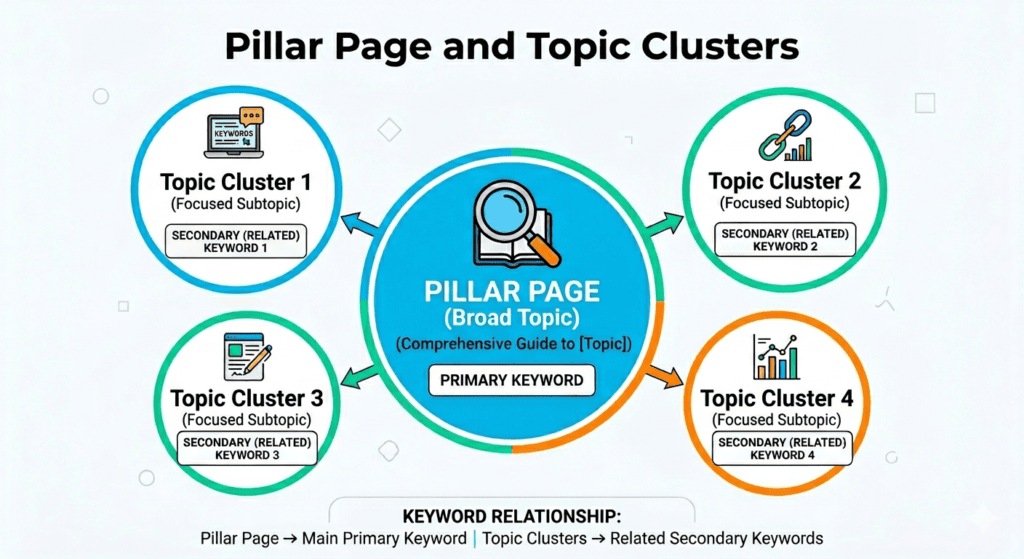
Group your target keywords into thematic clusters, each with one primary keyword. Create a comprehensive pillar page for each broad topic, supported by multiple detailed subtopic articles. Once published, link your supporting subtopic articles directly back to your main pillar page and vice versa to distribute authority throughout the cluster.
Use Content Briefs to Ensure Consistency
Write detailed outlines for your content writers, specifying the target word count, core headings, and user intent requirements. This maintains a consistent brand voice, structure, and visual style across all content assets, even when content is produced by multiple writers and editors.
Optimize Content for Users and Search Engines
Writing great content is only half the battle – you must format it so search engine algorithms can easily parse it. Modern on-page optimization requires a perfect blend of technical structure and high-quality writing. At a minimum, every piece of content should include:
- Demonstrated E-E-A-T principles: Show Experience, Expertise, Authoritativeness, and Trustworthiness by featuring author bios, citing reputable sources, and sharing original data.
- Optimized page elements: Craft compelling page titles and meta descriptions that accurately describe page content and entice searchers to click through to your site.
- Proper heading hierarchy: Use a single H1 tag for your title, H2 tags for your major sections, and H3 tags for supporting points.
Keep Your Content Strategy Agile
The search marketing landscape changes rapidly due to regular algorithm updates, new search features, and consequent shifts in user behavior. A strategy that cannot adapt will lose its competitive advantage over time. Review your overarching plan every quarter and make adjustments if needed, focusing on the topics that are currently driving the most impact.
Additionally, stay informed on major search engine updates so you can quickly adjust your formatting or technical setups to maintain your rankings.
How to Measure the Success of Your Content Strategy
To monitor the progress of your SEO content strategy, you need to go beyond basic data collection and focus on actionable insights. Leverage Google Analytics 4 specifically to understand user behavior, analyzing engagement patterns like user paths and scroll depth. This will allow you to check whether your content actually holds attention.
In addition, use Google Search Console to audit your organic visibility, tracking indexing status, organic impressions, and click-through rates. Finally, utilize SEO tools like SEMrush or Ahrefs to monitor keyword rankings and your backlink profile. Here is a table summarizing what to measure and how:
| Metric Category | Key Performance Indicator (KPI) | Why It Matters | Tools to Use |
| Visibility | Organic Impressions | Proves that search engines are finding, indexing, and serving your content to users in search results. | Google Search Console |
| Visibility | Keyword Rankings | Tracks your exact position in search results and validates that your content gains more visibility over time. | Google Search Console SEO Software (SEMrush/Ahrefs) |
| Engagement | Average Engagement Time | Indicates whether your content is relevant and satisfies the user’s search intent. | Google Analytics 4 |
| Engagement | User Paths | Shows how users navigate through your topic clusters and whether your internal links successfully lead them to related pages. | Google Analytics 4 |
| Engagement | Scroll Depth | Confirms whether readers are actually reading your articles in full. | Google Analytics 4 |
| Authority | Backlinks | Proves your content is a high-value industry resource, which boosts your site’s overall ranking power. | SEO Software (SEMrush/Ahrefs) |
| Business Impact | Conversions | Tracks specific user actions (sign-ups, downloads, form fills) that turn site visitors into qualified leads. | Google Analytics 4 |
| Business Impact | Revenue | The primary financial metric that connects your content strategy’s performance directly to the business goals. | Google Analytics 4 |
In addition, monitor your Google Analytics and Search Console consistently to identify performance weaknesses and leverage opportunities for content optimization:
- Fix high-impression, low-click pages: If a page ranks well but has a low click-through rate, rewrite the page title and meta description to make the search snippet more compelling.
- Optimize high-traffic, low-conversion pages: If a page gets many views but few conversions, add clearer, contextual calls to action (CTAs) or a lead magnet.
- Consolidate underperforming content: If multiple weak or outdated pages are targeting similar search terms, merge their unique insights into a single, authoritative guide to eliminate keyword cannibalization. This will also help consolidate your topical authority for AI agents.
Frequently Asked Questions
Generally, it takes three to six months to see meaningful traffic gains from a new content strategy. Search engines require time to index your pages, assess their quality, and properly establish your overall topical authority.
You can, but you risk creating content that nobody is searching for. Keyword research ensures your content writing efforts align directly with existing market demand and verified search volume.
Audit your high-priority content every six to twelve months to maintain its accuracy and relevance. Focus your updates on pages experiencing traffic declines or those that rank at the bottom of the first page or the second page of search results.
No, you should prioritize updating posts that already have search impressions or high conversion potential. Focus your efforts on content where an update can yield the quickest gains in traffic and revenue. Completely irrelevant or low-quality posts can be consolidated or deleted.
Conclusion
A successful SEO content strategy relies on clear goals, thorough planning, detailed keyword research, and regular optimization. This consistent approach builds a reliable source of search traffic that drives long-term business growth.
To learn actionable tips on how to create SEO-friendly content, see the content section of this full checklist.
