
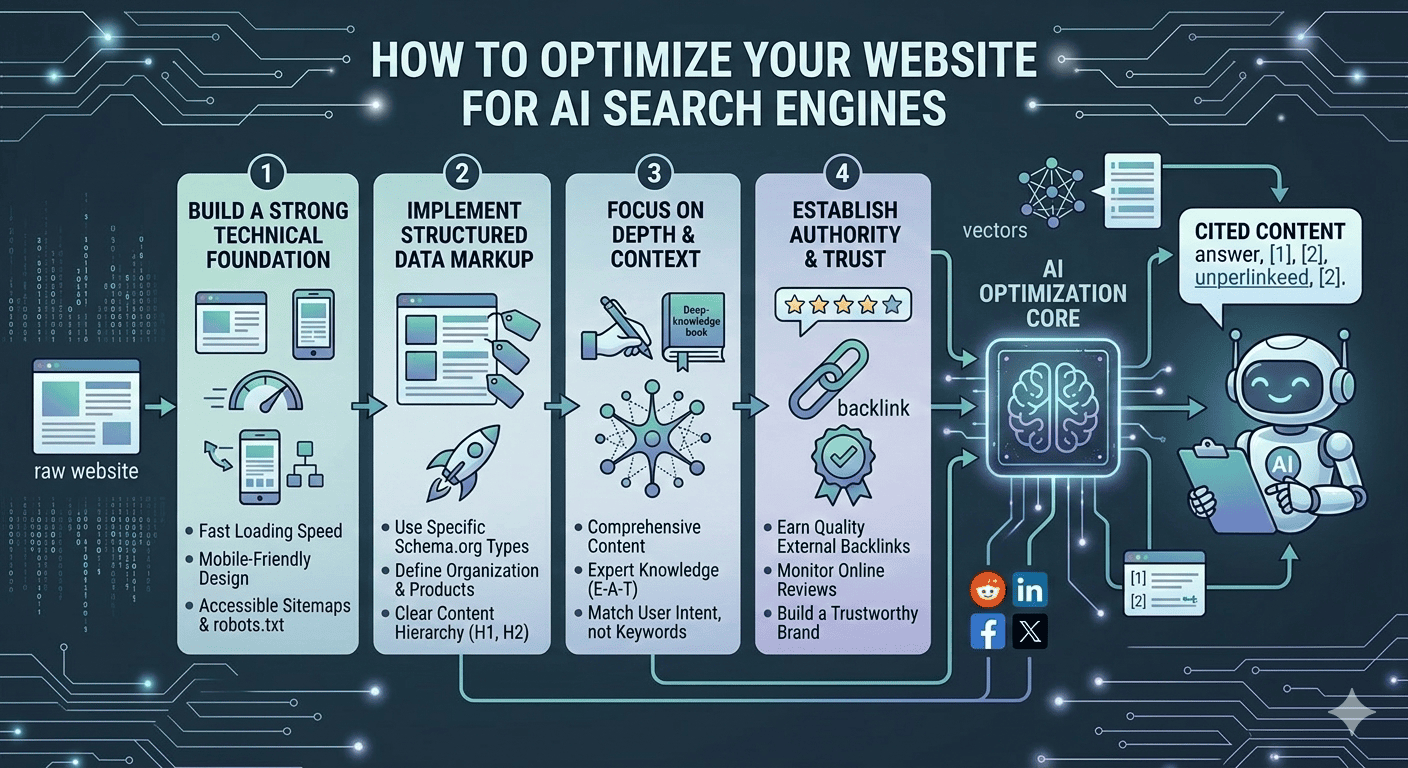
With the advent of generative AI, the way people search for information has changed dramatically. We still have traditional search results with blue links, but AI-generated answers are rapidly expanding in various forms and formats.
In this article, we’ll cover the essential AI search engine optimization theory and provide practical recommendations on how to get your site cited by AI search engines.
What is AI Search Engine Optimization?
AI Search Optimization is the process of making your website’s content easy for AI search engines to understand and trust, so they choose to cite your site as a source in their generated answers.
You might also hear terms like Generative Engine Optimization (GEO) or Answer Engine Optimization (AEO). Regardless of the name, the goal remains the same: make your site a source for AI-generated responses.
What is an AI Search Engine?
An AI search engine is an advanced search system designed to handle complex queries (prompts), browse the live web in real time, and generate human-like responses. Unlike traditional search engines, which primarily find information and provide a list of links, AI search engines synthesize information to answer complex queries directly. They are powered by Large Language Models (LLMs), which allow them to process web data and generate natural, conversational answers.
The development of AI search began in late 2022 when OpenAI launched ChatGPT – the world’s first publicly available generative AI chatbot. Around the same time, Perplexity debuted as one of the first true AI “answer engines” built specifically to search the live web.
In March 2023, Google introduced its own competitor, Bard, which was later rebranded as Gemini. Microsoft also launched its own generative AI chatbot in 2023, which has since been rebranded as Copilot and integrated into the Bing ecosystem.
How AI Systems Work
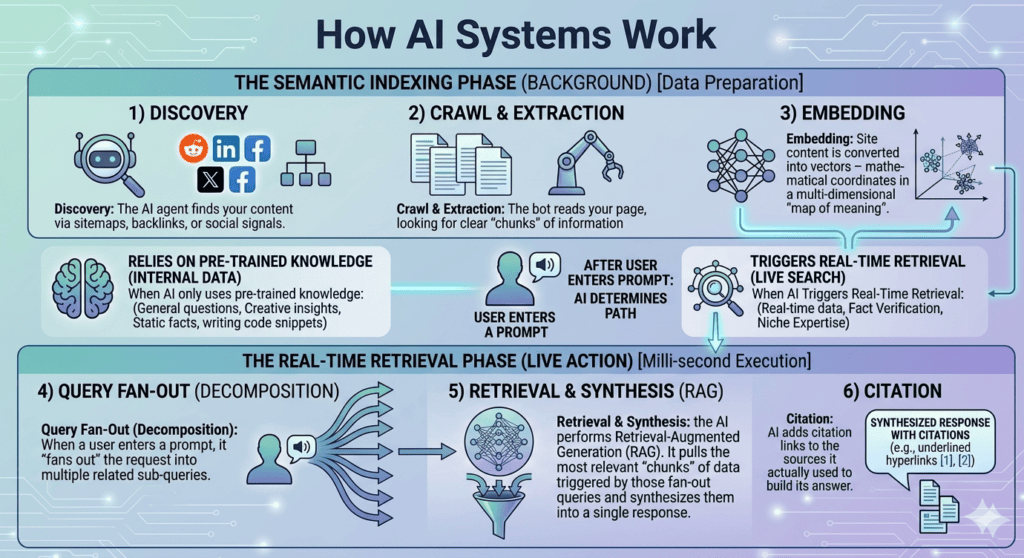
AI search engines don’t rank websites in the traditional sense. To understand how AI systems work, we have to look at two distinct phases: what happens in the background, and what happens after a user enters a prompt.
The Semantic Indexing Phase
This happens periodically as the AI crawlers explore the web to “learn” what our sites are about. This phase consists of three main stages:
- Discovery: The AI search engine finds your content via sitemaps, backlinks, or by tapping into established search engine indexes (like Bing or Google) via APIs.
- Crawl & Extraction: The bot reads your page. It prioritizes text that is easy to parse, looking for clear “chunks” of information (headers, lists, and concise paragraphs).
- Embedding: At this stage, site content is converted into vectors – mathematical coordinates in a multi-dimensional “map of meaning”. This allows the AI to understand that your content is conceptually related to a certain topic, even if you don’t use those exact keywords.
The Real-Time Retrieval Phase
This stage happens in milliseconds once a user enters a prompt.
- Query Fan-Out (Decomposition): When a user enters a prompt, the AI doesn’t just search for those specific words. It “fans out” the request into multiple related sub-queries to explore different angles, definitions, and sub-topics simultaneously.
- Retrieval (Live Web Search): The AI uses those fanned-out sub-queries to execute a live search across the web. Using the “map of meaning” created in the Embedding phase, it pulls the most relevant “chunks” of text from live web sources. This entire process of fetching live data to generate an answer is called Retrieval-Augmented Generation (RAG).
Important note: The Query Fan-Out and Retrieval (Live Search) stages are only performed if the system detects a knowledge gap or requires live data. If the AI recognizes that external context is unnecessary, it skips these two steps entirely and jumps straight to Synthesis using its pre-trained knowledge.
- Synthesis (Generation): The core Large Language Model (LLM) compiles (generates) the actual response. If the live search was triggered, the LLM synthesizes the external web chunks together with your prompt into a cohesive answer. If the search was skipped, the LLM synthesizes the answer using only its internal, pre-trained knowledge.
- Citation: Finally, the AI adds citation links to the sources it actually used to build its answer.
Note: AI replies do not always contain citations. Links are only generated when the live search happens. If a prompt triggers only the AI’s pre-trained knowledge, it will answer from “memory” without linking to any external websites.
When AI Uses Live Search and Pre-Trained Knowledge
If every prompt triggered a live search, AI would be too slow and expensive to run. That’s why the AI determines if it needs to execute Retrieval-Augmented Generation or if it can rely solely on its pre-trained knowledge.
When AI only uses pre-trained knowledge
AI systems use pre-trained data when the answer can be generated from the knowledge that was established during the model’s initial training phase. This usually happens for:
- General questions;
- Creative insights (e.g., drafting emails or brainstorming ideas);
- Static facts and historical concepts;
- Logic & math-related prompts (e.g., solving equations or writing code snippets).
When AI Triggers Real-Time Retrieval
The AI triggers the Retrieval stage and live search when it recognizes a knowledge gap caused by the knowledge cutoff – the date when an AI model’s training data ends. This usually happens for:
- Real-time data, such as breaking news, stock prices, or recent events;
- Fact Verification: When a query requires high accuracy and the AI needs to verify authoritative sources;
- Niche Expertise: When the prompt is so specific that the model’s general training isn’t enough to provide a confident answer.
AI Hallucinations
All AI models are probabilistic, meaning they predict the next most likely word in a sentence based on probability. For example, if a user types “what is the highest…“, the AI predicts that the following words might be “mountain” or “paying job“. This occasionally leads to “hallucinations” – instances where the AI confidently presents entirely false information as fact.
Hallucinations typically happen when a model lacks specific data or prioritizes completing the answer over factual accuracy. This is why all facts in AI responses, especially specific statistics and niche details, must be verified for accuracy.
Traditional vs. AI SEO: Key Differences and Overlaps
Let’s explore how SEO has evolved after the integration of AI into core search algorithms.
To put it simply, AI Search Engine Optimization is a new, sophisticated “layer” on top of the existing SEO foundation. This means that SEO fundamentals haven’t gone away and remain important. If an AI search engine can’t discover, crawl, or retrieve your content, it will never cite it in its responses.
However, AI search engines work differently from the traditional Googlebot. The table below summarizes what stays the same and what changes in AI Search Engine Optimization compared to traditional SEO.
Comparison of Traditional vs. AI SEO Factors
| Factor | Traditional SEO Importance | AI SEO Importance |
| Crawlability & Indexing (URL structure, robots.txt, redirects, “noindex” tags, etc.) | Critical: If a page cannot be indexed, it won’t appear in search results. | Critical: If an AI search engine can’t discover a page, it can’t read and understand it. |
| Site Health (Duplicate content, broken links, canonical link issues, mixed HTTP/HTTPS content, etc.) | Medium/High: Depends on site size. For larger sites, technical health is essential to optimize the crawl budget and ensure a complete crawl. For smaller sites, issues like broken links or duplicate content primarily affect the user experience. | Medium: AI search engines can usually read your content even if a page has technical errors. However, duplicate content makes it difficult for AI to identify the original data source. |
| JavaScript Rendering | Low Risk: Googlebot is highly proficient at rendering JavaScript. | Possible Risk: AI systems like ChatGPT and Perplexity are generally less reliable than Googlebot at rendering JavaScript. However, Google Gemini can render JavaScript well because it shares the same infrastructure as Googlebot. |
| Site Speed and Core Web Vitals | Low/Moderate: A confirmed ranking factor, but rarely the primary one, acts more like a tie-breaker. | Medium: AI systems often search and fetch pages in real time, so server response time and page latency matter to them. If a page takes too long to deliver its HTML, the AI bot may skip your content to keep its response fast. |
| Schema Markup | Medium: Not a direct ranking factor, but necessary to get rich results (snippets) and increase click-through rates. | Medium-High: AI systems use Schema to identify entities and extract specific details from your content with high confidence. |
| Site Credibility & Content Accuracy (E-E-A-T Signals) | High: E-E-A-T is not a ranking factor in the traditional meaning, but it provides a framework for Google’s algorithms that seek helpful and reliable content. | High: AI search engines require verified facts and original research to provide reliable citations and minimize hallucinations. |
| Titles & Meta Descriptions | Medium: Primarily used to describe the page content in search results and improve click-through rates (CTR). | Low-Medium: AI systems use page titles for source cards and citations. Meta descriptions are less important, as AI can generate its own page summaries. |
| Heading Hierarchy | Moderate: Improves readability and helps crawlers understand the page’s structure, but traditional search engines primarily rank a page as a single, holistic unit. | High: AI systems segment content into “chunks” via headings to build synthesized answers. To be citable, content must be structured. |
| Internal Link Architecture | High: Important for distributing “link equity” (PageRank) and ensuring all pages are discoverable by crawlers. | Medium-High: Strategic internal linking establishes a semantic hierarchy, allowing AI systems to map relationships between pages within a given topic. |
| Backlink Profile | Essential: High-quality backlinks are one of the most important ranking factors for traditional search engines. | High: Backlinks are important for AI systems. If your content lacks high-quality backlinks, AI search engines may lack the necessary evidence to trust and cite your information. |
| Off-Site Mentions | Moderate: Mentions and social signals are not direct ranking factors; they primarily drive brand awareness and can increase branded organic traffic. | Medium-High: AI search engines track brand mentions across the web, even without hyperlinks. They evaluate the context and sentiment of these mentions. |
How to Track AI Visibility
AI visibility can’t be measured like traditional search rankings. Traditional rank tracking – monitoring your site’s position for a specific keyword – no longer works in AI-powered search. According to research, AI recommendation lists repeat their exact order less than 1% of the time. If you ask an AI the same question twice, you will likely get two different lists.
This happens because AI models are probabilistic, not static. Therefore, to track AI visibility, we need to use metrics that measure how often your site appears across various AI-powered responses.
Key Performance Indicators in AI SEO
In AI Search Engine Optimization, key KPIs are citations, mentions, share of voice, and sentiment. These metrics measure how effectively AI systems recognize and utilize your content.
Citations
This metric measures how often AI-generated responses contain a direct link to your website. These citations typically appear as inline numbers, footnotes, or clickable text embedded within the AI’s answer.
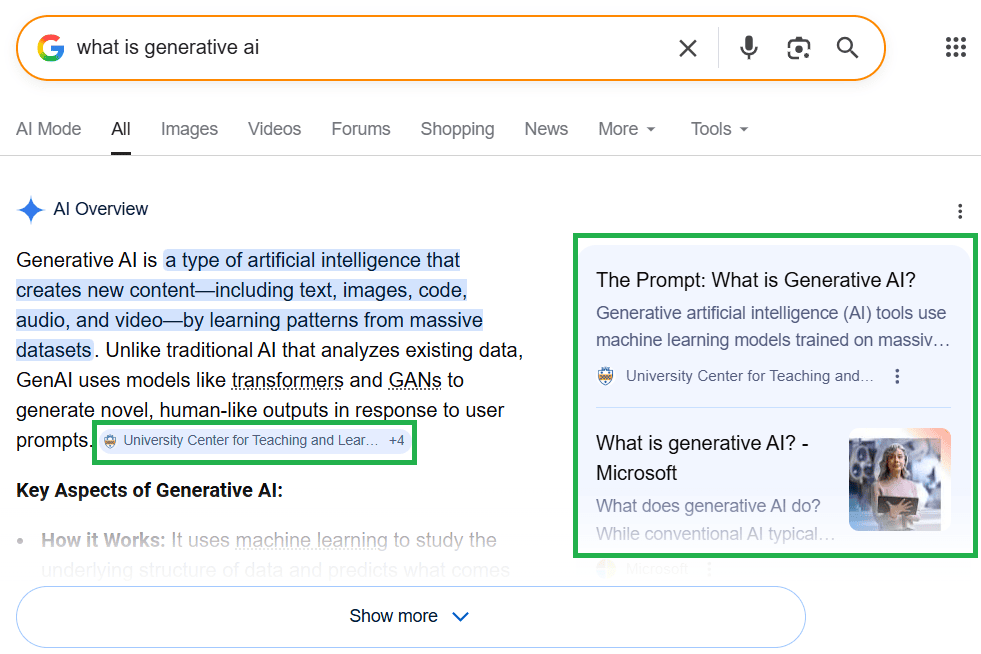
Citations matter because they show users that reputable sources power AI-generated answers, allowing them to verify accuracy and transparency.
Mentions
This metric measures how often an AI-generated response includes your product, service, or brand without a direct link. Mentions typically appear within lists, comparisons, or recommendations.
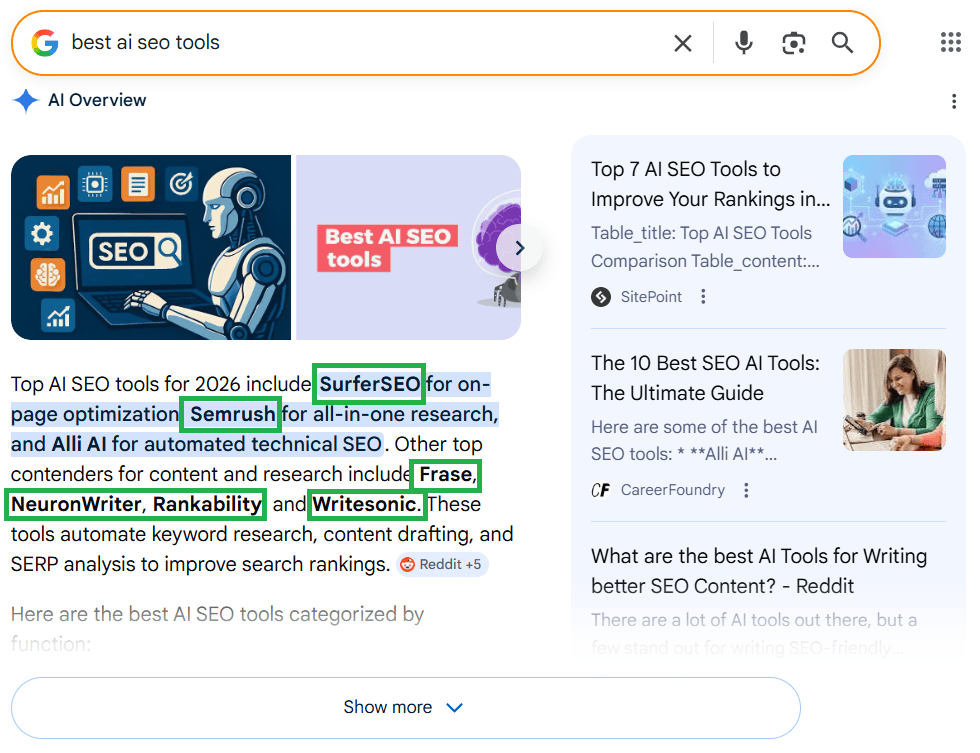
Mentions signal to users that your brand is a recognized authority within its niche.
SOV measures your brand’s presence across an entire topic. This is the percentage of generative responses in your industry that include your brand versus your competitors.
For example, if users ask an AI 100 different questions related to “best Answer Engine Optimization software”, your share of voice shows what percentage of those answers include your brand.
Sentiment
Sentiment tracks the tone in which your product, service, or brand is discussed: positive, negative, or neutral. This metric is important because AI systems can use sentiment to decide which entities to recommend.
AI Search Engine Optimization Best Practices
The following recommendations will help maximize your site’s visibility in AI-generated answers across all AI-powered search experiences.
Ensure AI Crawlers Can Access Your Content
AI crawlers must first be able to discover and crawl your site before citing it in their generative responses. They generally respect ‘noindex’ tags and robots.txt directives for real-time retrieval. If a page is blocked from being crawled or has a ‘noindex’ tag, AI will skip it when looking for citations.
However, these directives do not remove content from an AI’s existing training data. If an AI model used your content for training before you added the ‘noindex’ tag or blocking rule to robots.txt, it can still “remember” and use that information in a response, although it is less likely to provide a citation link.
You also need to make sure that your server or any site security features do not specifically block AI crawlers.
Minimize JavaScript-dependent content in the initial HTML
Google Gemini can execute JavaScript well, but other AI search engines, such as ChatGPT and Claude, may not execute JavaScript as well as Google. If your core content relies on client-side scripts to load, these AI systems may miss it.
Therefore, prioritize Server-Side Rendering to ensure your important text is present in the initial HTML response from your server. This allows AI crawlers to crawl your content instantly without requiring the execution of JavaScript.
Implement relevant Schema Markup across the entire site
Use the most specific Schema type possible. For example, use Dentist instead of LocalBusiness for a dental clinic website. Implement Product, Organization, and Review markup wherever applicable.
Schema markup must exactly match the visible content on the page. Otherwise, AI systems may skip the markup entirely.
Structure Content with Headings for Easy Retrieval
AI systems rarely process an entire webpage at once. Instead, they crawl and retrieve specific “chunks” of text to answer user prompts. To make your content easy for AI to extract and understand, use logical headings and well-structured paragraphs.
Use only one H1 per page for the main topic, H2s for main sub-points, and H3s for deeper details. Follow this heading hierarchy without skipping levels, as AI uses these tags to map out where thoughts begin and end.
Keep paragraphs concise and start with the main fact. Each paragraph should represent a complete answer to a potential question. If an AI system extracts only one paragraph from your page, that chunk must make sense completely on its own.
Prioritize Facts, Statistics, and E-E-A-T signals
AI models look for verifiable data. If you mention a fact or statistic, cite the specific number and link to the original research.
Including verified data sends strong E-E-A-T signals to AI models. Expert-written content backed by verified data significantly increases your chances of appearing in generative responses.
Use Images & Video in Your Content
Modern AI search engines are multimodal, meaning they can simultaneously process text, recognize images, and understand video content. This allows users to perform complex searches, such as uploading an image and asking specific questions about it.
Use high-resolution, unique visuals that the AI cannot find elsewhere. Implement ImageObject and VideoObject Schema to provide AI systems with explicit metadata. For video, always provide a transcript to ensure the AI can recognize the spoken content.
Build Off-Site Authority
If someone searches for information related to your brand (service, product), AI systems don’t just look at your site – they cross-reference your claims with the rest of the web.
According to SEMRush research, AI search engines place particular importance on what people say on Wikipedia, Reddit, Quora, and industry-specific sites. So if your brand, product, or service is frequently mentioned on these platforms, it has a higher chance of being mentioned in AI-generated responses.
Conclusion
The way people search for information has evolved from typing keywords and clicking blue links to writing complex prompts and receiving synthesized AI-generated answers. With this shift, the goal of SEO has moved from ranking for keywords to being cited and mentioned by AI search engines.
Success in AI Search Engine Optimization still relies on traditional SEO practices, but requires additional optimization efforts specifically for LLMs. Start optimizing for AI search today to ensure your brand remains visible across the AI-powered search experiences of tomorrow.
For more insights on how to use AI tools for SEO tasks, read the guide on generative AI for SEO.
